Łukasz Mamica – university lecturer (born in 1971 in Kraków). A creator of sculptures (referred to as “re-forms”) made of cast aluminum with a conceptual character. He gives existing objects, including topographical ones, a new form, whose context is revealed through accompanying animations. His work refers, among other things, to issues of environmental protection, transience, and the rights of humans and animals.
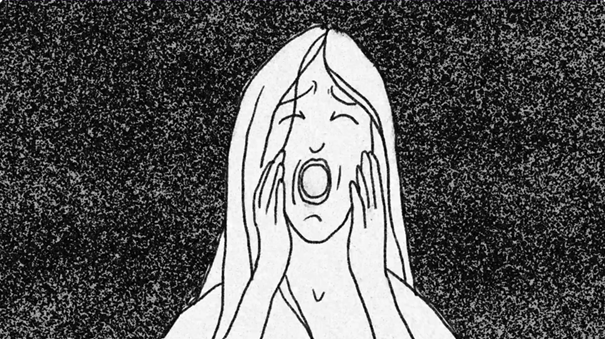
Films about his work So far, two films have been made presenting the work of Łukasz Mamica. The most recent, “Re-forms NO”, directed by Magda Śliwa in 2026 (on the left). The earlier one, titled “Re-forms” (2025), is also available on YouTube via a link.
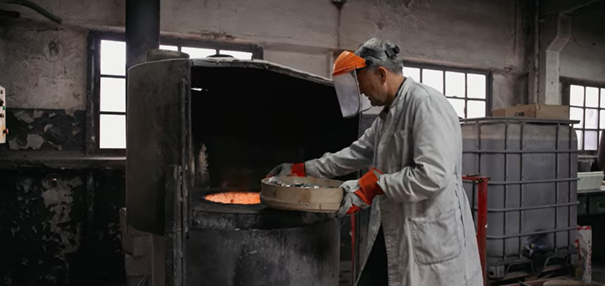
Sculptural technique and material The sculptures are created through a smelting and casting process using aluminum sourced from cans collected by the artist from public spaces, which gives them an ecological dimension (link to a foundry recording).
Themes The themes of the sculptures often address the negative impact of humans on the environment (“Seas of Fashion,” “Apocalypse now – Gdańsk”), opposition to animal fur farming (“The Price of Fashion”), as well as resistance to war and violence (“Dead Peace,” “Dead Border -UA,” “Viktoria 27”), and the human body (“V-189,” “A-”).
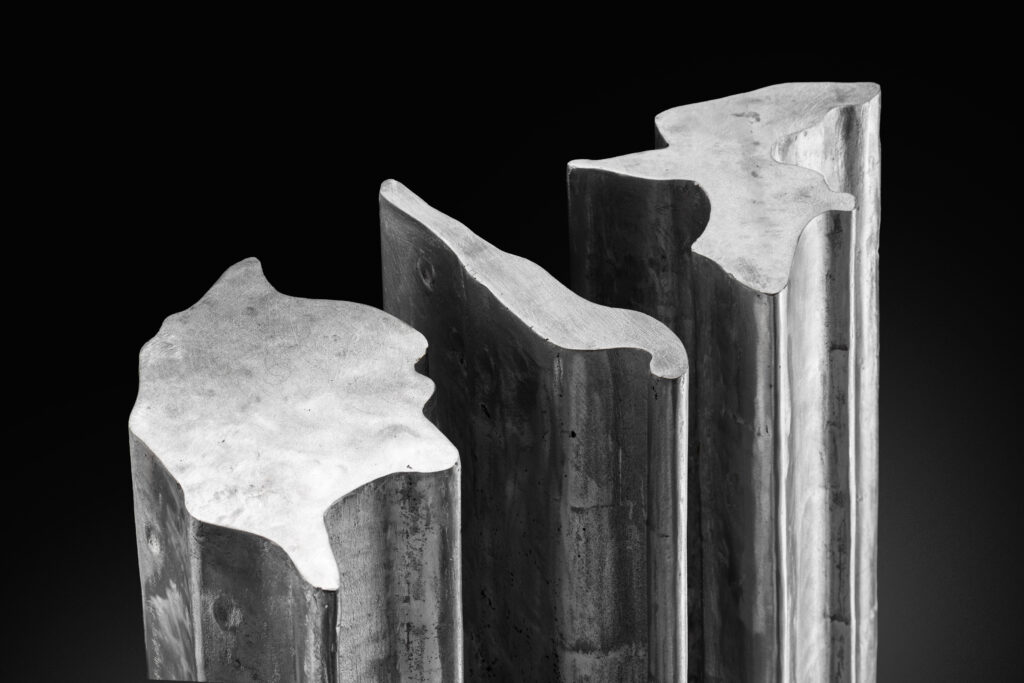
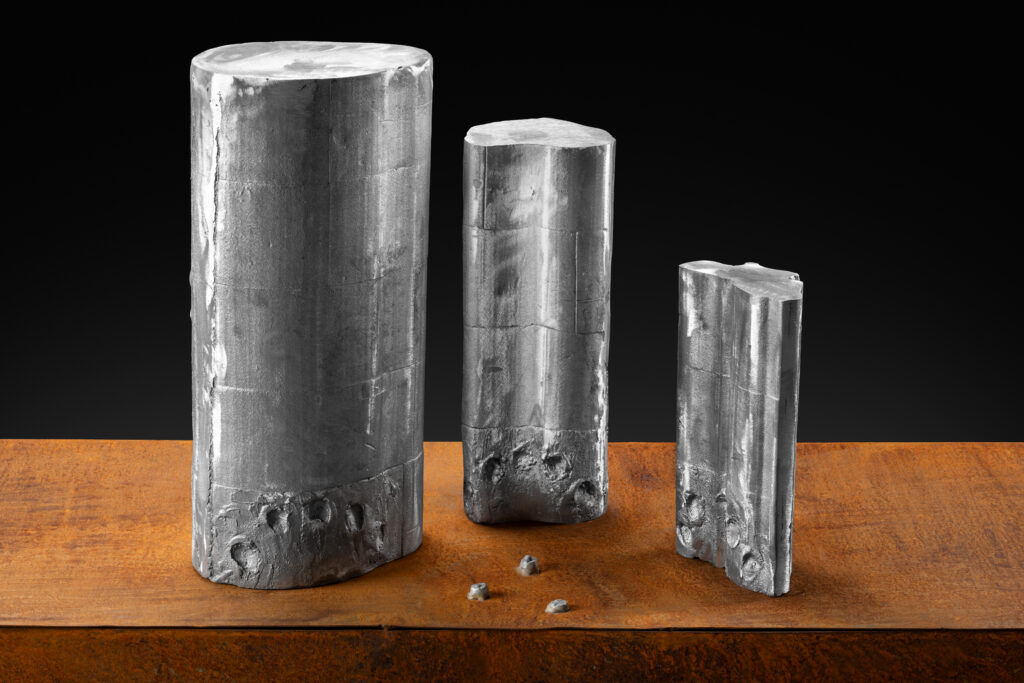
The photo shows the “Seas of fashion” series (from left: a shape referencing the Aral Sea in 1960, in the center the Aral Sea in 2025, and on the right a form inspired by a clothing landfill in the Atacama Desert in Chile).
Meaning of the term “re-forms” The term “re-forms,” used to describe the sculptures, refers both to the creative transformation of existing forms of selected objects and to the change in the form of matter during the casting process of recycled aluminum.
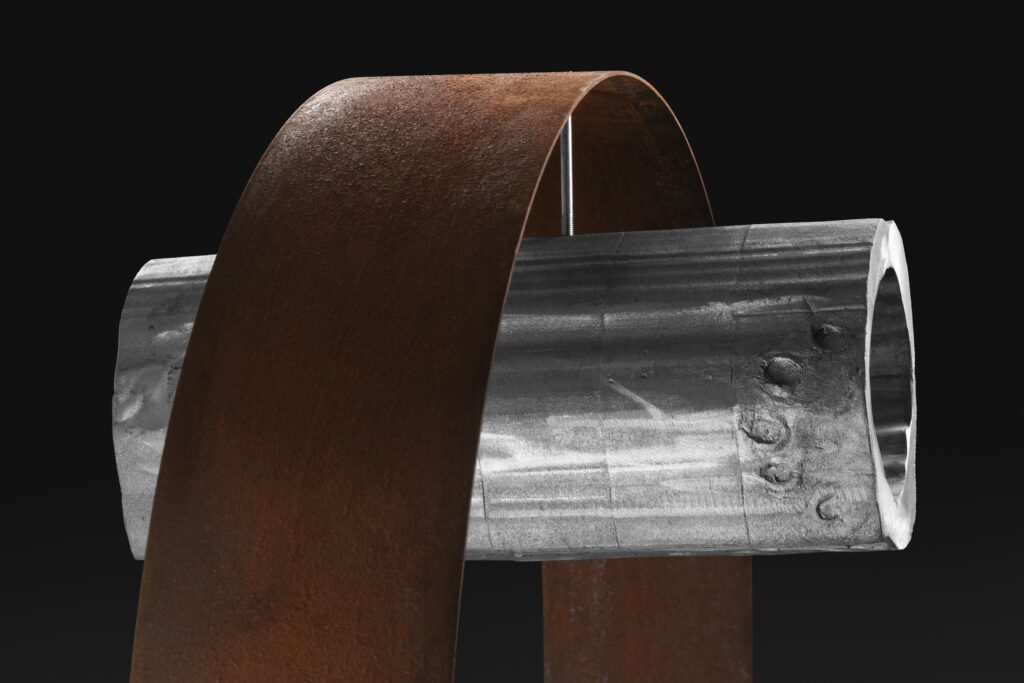
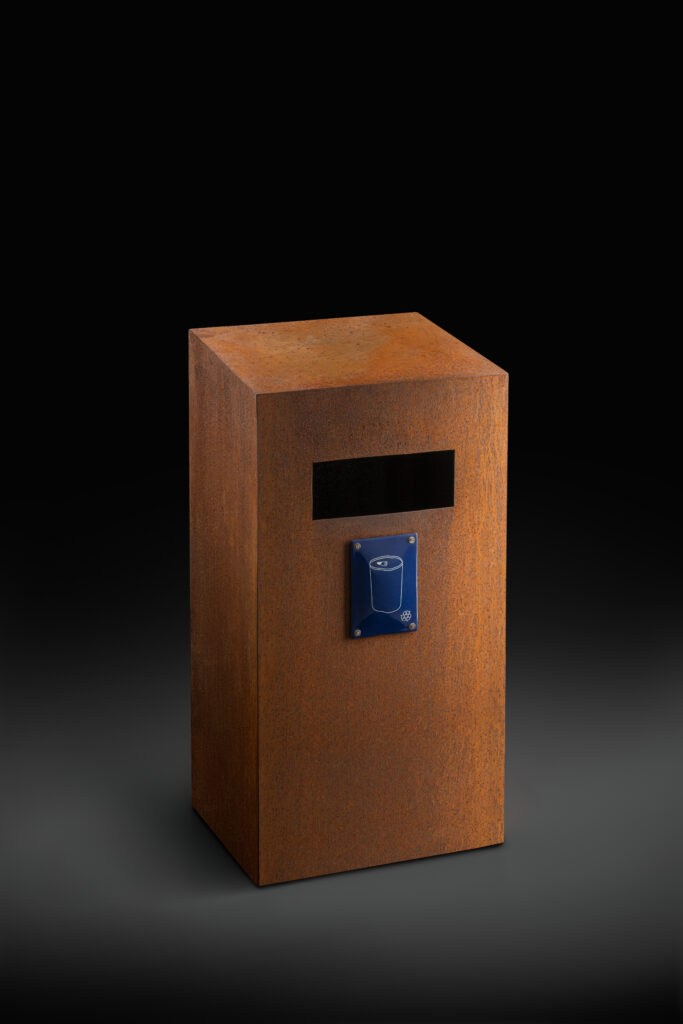
Sculpture pedestals The pedestals are made of rust-coated steel. They feature openings for depositing aluminum cans, which are then used to create subsequent sculptures. The exhibitions are also accompanied by freestanding can-collection containers with enameled plaques.
The significance of the graphic animations accompanying most sculptures The several dozen–second animations, created by graphic artists, present the context behind the sculptures and convey their message. For example, the animation “Seas of Fashion” contributes to the discussion about our role in one of the greatest ecological disasters—the disappearance of the Aral Sea. Since 1960, the rivers flowing into it have been diverted into the desert to support cotton cultivation. At the same time, in the Atacama Desert in Chile, the world’s largest landfill of discarded clothing has emerged.
At exhibitions, QR codes are placed alongside the descriptions of individual sculptures, linking directly to the corresponding animations so that visitors can easily view them. Some animations are also displayed in loops on monitors accompanying the exhibition. Selected animations include: “The Price of Fashion,” “Dead Peace UA,” “MOMO (Seas of Fashion),” “Rose,” “Dead Border,” and “NO.”
Form The sculptures are, for the most part, conceptual and non-figurative. Contrary to appearances, however, they are not abstractions but rather transformations of specific objects, geographical spaces, or the human body. To reveal the inspiration behind each piece, they are accompanied by animations created by graphic artists, for which music is often specially commissioned.
Ta strona korzysta z ciasteczek aby świadczyć usługi na najwyższym poziomie. Dalsze korzystanie ze strony oznacza, że zgadzasz się na ich użycie.